Charles A Taylor
Environmental economics with a focus on climate, agriculture, land use, migration, and economic history. I like using satellite data and remote sensing products to help answer policy questions.

About me
I am an assistant professor at the Harvard Kennedy School, a Faculty Research Fellow at NBER, and previously a S.V. Ciriacy-Wantrup postdoc at UC Berkeley ARE. I am an Associate Editor at the Journal of the European Economic Association.
I do applied research on environmental topics. I have taught environmental economics at Columbia, City College of New York, and Fordham University. Before academia, I worked at McKinsey & Company, the Bill & Melinda Gates Foundation as an agricultural consultant, and The Earth Partners LP, a land and environmental investment company, and I advise a niche agri-commodity exporting company. I co-founded Drylands Natural Resource Centre, a farmer-owned cooperative and research center.
I have a PhD in Sustainable Development from Columbia University, and a BA in Economics and in Political & Social Thought from the University of Virginia.
CV


Research
Working Papers
“Paving the Swamp: Consequences of Land Use Regulation Under the Clean Water Act” with Hannah Druckenmiller and Joseph S. Shapiro (extended abstract)
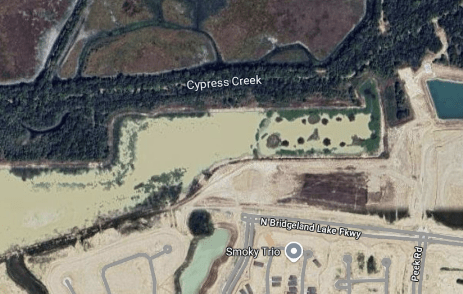
How does environmental regulation of land use affect the environment and the economy? We analyze how dramatic recent changes in Clean Water Act regulation due to White House and Supreme Court rules, measured using geophysical data and machine learning algorithms, affect property values and land use. Four findings emerge. First, recent rule changes greatly alter regulatory stringency. Second, regulation substantially decreases values of non-residential land parcels with water resources. Third, regulation decreases development activity, as measured from permitting and satellite data. Fourth, we calculate implied costs of this regulation.
“Migration, Climate Similarity, and the Consequences of Climate Mismatch.” NBER Working Paper (with Marguerite Obolensky and Marco Tabellini)
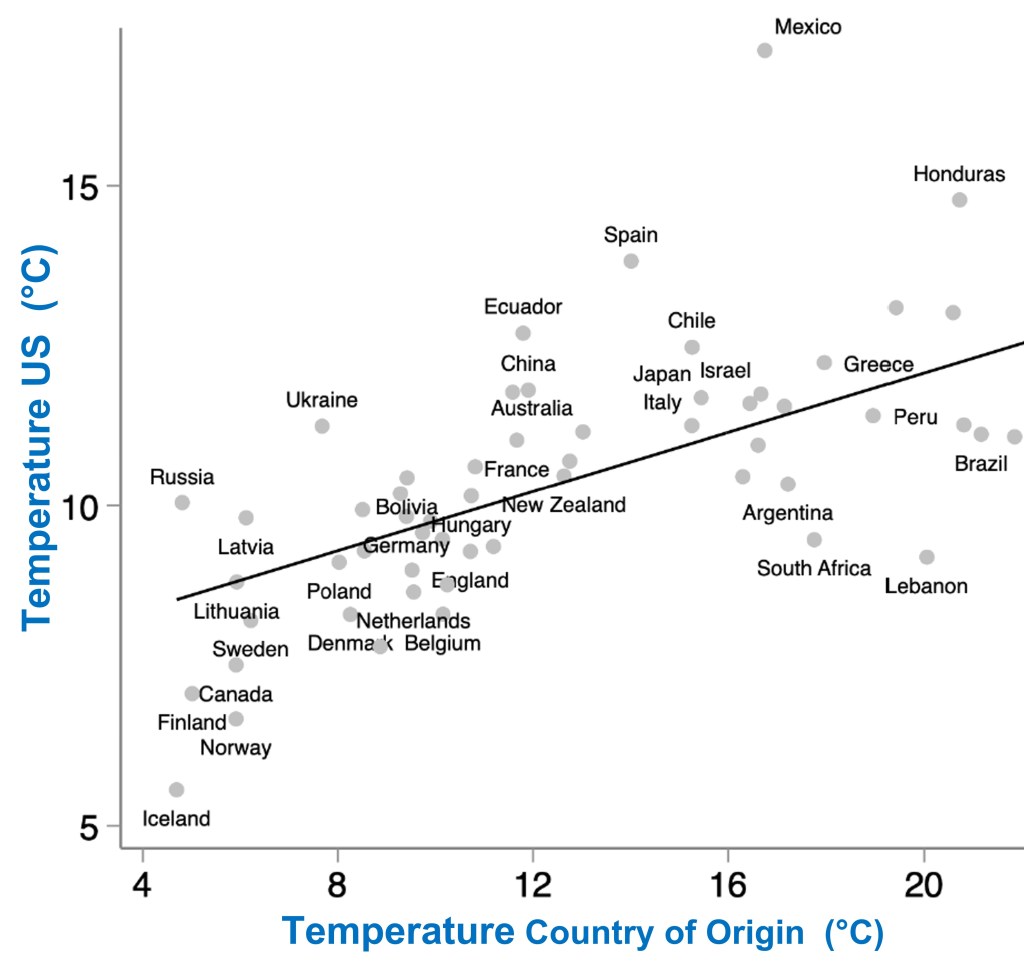
This paper examines the concept of “climate matching” in migration—the idea that migrants seek out destinations with familiar climates—and studies its implications for the geography of economic activity in the United States. We document that temperature distance between origin and destination predicts the distribution of migrants across U.S. counties, for both internal and international migration in the historical (1850–1940) and modern (1970–2019) periods. These patterns cannot be explained by the spatial correlation of climate or the persistence of ethnic networks, and instead reflect two mechanisms: the transferability of climate-specific skills and climate as an amenity. We then study the economic consequences of climate mismatch during 1880–1920, a period of rapid growth and structural transformation. Using an instrumental variable strategy that interacts origin-country inflow shocks with the timing of county railroad access, we find that mismatch reduced agricultural productivity and accelerated the exit from farming. Further, manufacturing productivity declined and population growth was lower in mismatched counties . These effects left a lasting imprint: a 1°C increase in 1880–1920 mismatch is associated with 2.5% lower per capita income in 1940.
“Rain follows the forest: Land use policy, climate change, and adaptation.” Working Paper (with Florian Grosset and Anna Papp). Review of Economic Studies, revise and resubmit.
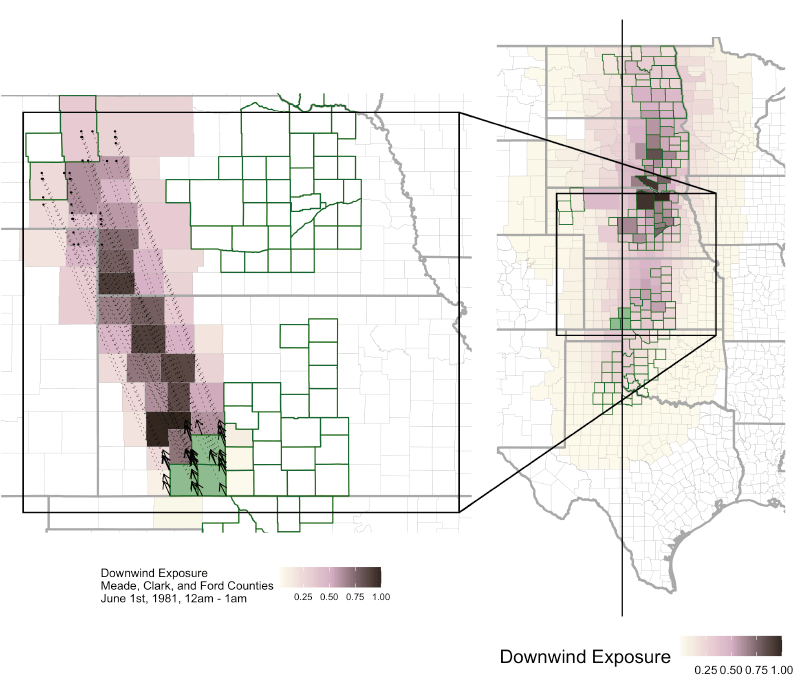
Human actions can alter the climate via land use. We analyze the 1930s Great Plains Shelterbelt, a large-scale forestation program across the US Midwest. The program increased precipitation and decreased temperatures for decades. Changes extended 200km downwind – enabling us to study climate adaptation. Improved growing conditions allowed farmers to expand corn acreage, adopt water-intensive practices, and reduce crop failures. In a period of farm consolidation, this contributed to the survival of small farms but less farm machine usage. The findings underscore the endogeneity of climate to land use change and the long-term impacts of tree planting on agricultural development.
“Airlines, Pollution, and Health.” Working Paper (with Xinming Du).
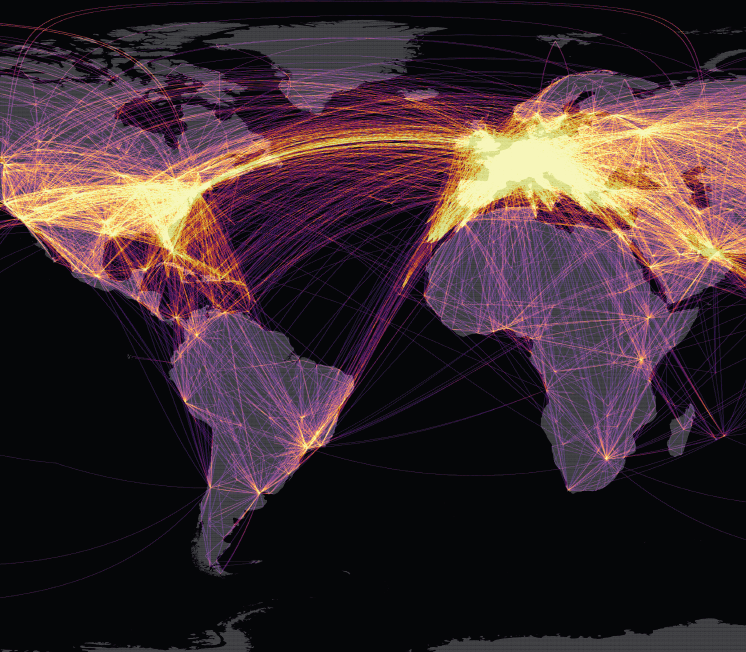
This paper demonstrates a large but little-known negative externality of the aviation industry. Using a new instrument for air pollution from aircraft cruising, we show that pollution is higher beneath overhead flight routes in ways uncorrelated with local pollution. We combine this cross-sectional variation with the launch of new flight routes to establish several findings. First, aircraft cruising persistently elevates local PM2.5 by 1–3 μg/m3, which allows us to estimate the long-term impacts of pollution exposure. Second, we leverage this variation and show that PM2.5 has adverse impacts on adult mortality and infant health via lower birth weights. Third, pollution from aviation pushed some US counties into nonattainment under the Clean Air Act.
“Cicadian Rhythm: Insecticides, Infant Health and Long-term Outcomes.” Working Paper (JMP)
Wallace E. Oates Outstanding Doctoral Dissertation Award, Association of Environmental and Resource Economists (AERE).

Pesticides are linked to negative health outcomes, but a causal relationship is difficult to establish due to nonrandom pesticide exposure. I use a peculiar ecological phenomenon, the mass emergence of cicadas in 13 and 17-year cycles across the eastern half of the US, to estimate the short and long-term impacts of pesticides. With a triple-difference setup that leverages the fact that cicadas only damage tree crops and not agricultural row crops, I show that insecticide use increases with cicada emergence in places with high apple production. Exposed cohorts experience higher infant mortality and adverse health impacts, followed by lower test scores and higher dropout rates. I exploit geo-spatial sources of variation and find evidence for pesticide exposure through a water channel. Moderate levels of environmental pollution, not just extreme exposure, can affect human health and development. The study design, which encompasses the entire chemical era of US agriculture since 1950, provides insights into the regulation of pesticides in the US and globally.
“Environmental Drivers of Agricultural Productivity Growth: CO2 Fertilization of US Field Crops.” Working Paper (with Wolfram Schlenker).
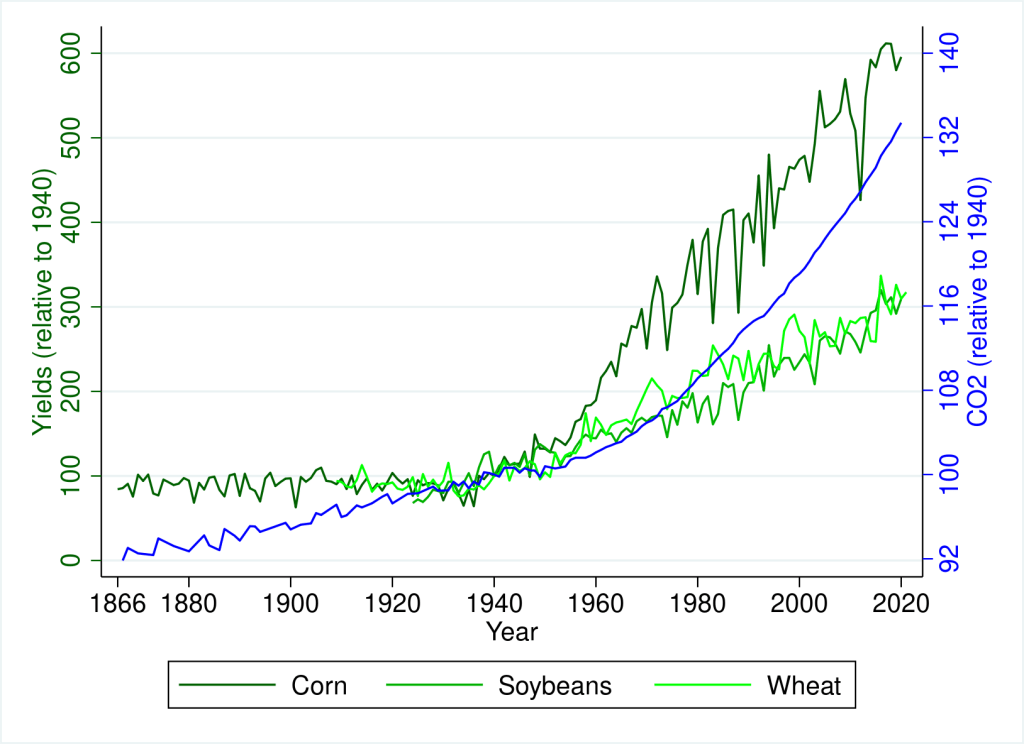
We present a novel methodology to estimate the CO2 fertilization effect on crop yields using data from NASA’s Orbiting Carbon Observatory satellites. Our study complements field and chamber experiments by examining county-level crop yields under actual growing conditions across the majority of US cropland. For identification, we utilize remotely sensed, year-to-year CO2 anomalies from county-specific trends and further instrument for these anomalies using wind patterns. We find a CO2 fertilization effect greater than that reported in most field and chamber experiments. In a thought exercise, we apply the CO2 fertilization effect estimated in our sample from 2015–2022 backward to 1940. Assuming no other limiting factors, we find that rising CO2 was a major driver of past yield growth, particularly for wheat—with important implications for estimates of future climate change damages.
“Irrigation and Climate Change: Long-run Adaptation and its Externalities.” Working Paper. Journal of the Association of Environmental and Resource Economists, revise and resubmit.
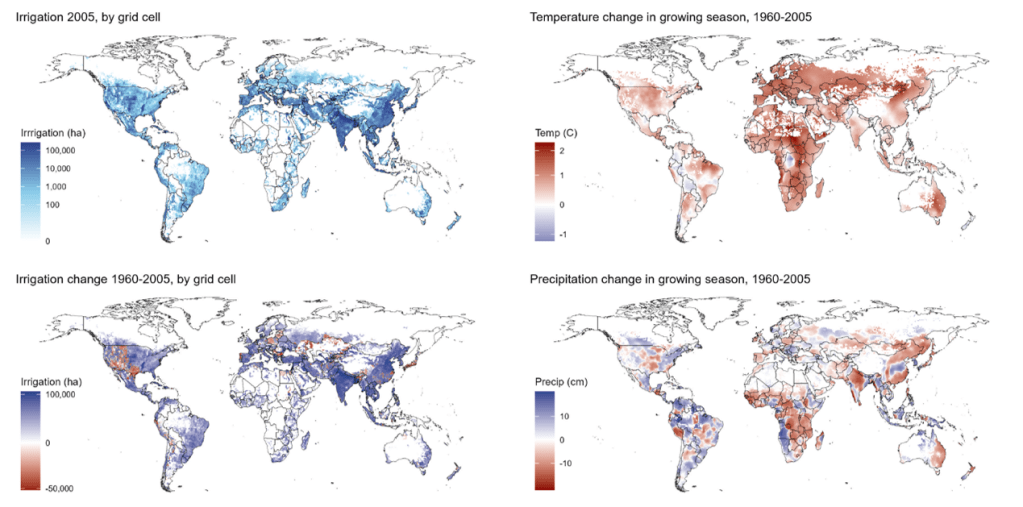
As the largest user of water, irrigated agriculture accounts for 20% of global cropland and over 40% of food production. Irrigation is also a potential adaptive response to climate change. This paper examines the extent to which the current global irrigation footprint reflects climate change over the last 50 years. Utilizing variation in local climate, I find that increasing drought conditions over time are associated with irrigation expansion in areas with groundwater potential. The results hold both globally and in the US. GRACE satellite data suggest that this expansion of irrigation can contribute to aquifer stress and increased soil salinity, which represent potential negative externalities of climate adaptation and a threat to future food security.
***
Selected works in progress
“Land Conservation and the Clean Energy Transition” with Meredith Fowlie
“Climate and Prehistoric Migration” with Peter Huybers, Marco Tabellini, and Francesco Toti
“A Hedonic Social Cost of Carbon: Evidence from US Migration” with Tamma Carleton, Marco Tabellini, and Guglielmo Zappalà
“The ‘Golden Age’ of Pesticides? Trade-offs of DDT and Health in the US” with Eyal Frank
“The Value of Water Quality: Evidence from Fertilizer and Algal Blooms” with Xinming Du
***
Publications
“Wetlands, Flooding, and the Clean Water Act.” American Economic Review (with Hannah Druckenmiller), 2022

In 2020 the EPA narrowed the definition of ‘Waters of the United States’, significantly limiting wetland protection under the Clean Water Act. Current policy debates center on the uncertainty around wetland benefits. We estimate the value of wetlands for flood mitigation across the US using detailed flood claims and land use data. We find the average hectare of wetland lost between 2001 and 2016 cost society $1,840 annually, and over $8,000 in developed areas. We document significant spatial heterogeneity in wetland benefits, with implications for flood insurance policy and the 50% of ‘isolated’ wetlands at risk of losing federal protection. (ungated) (replication)
“Market Expectations of a Warming Climate.” Journal of Financial Economics (with Wolfram Schlenker), 2021

We compare prices of financial derivatives whose payouts are based on future weather outcomes to CMIP5 climate model predictions as well as observed weather station data across eight cities in the US from 2001 through 2020. Derivative prices respond both to short-term weather forecasts for the next two weeks and longer-term warming trends. We show that the long-term trends in derivative prices are comparable to station-level data and climate model output. The one exception is February in the northeastern US, where financial markets price in a polar vortex-induced cooling effect, a recent scientific finding that was not present in the older CMIP5 climate output. When looking at the spatial and temporal heterogeneity in trends, futures prices are more aligned with climate model output than observed weather station trends, suggesting that market participants closely align their expectations with scientific projections rather than recent observations. (online appendix) (replication)
“Livestock Plants and COVID-19 Transmission.” Proceedings of the National Academy of Sciences (with Chris Boulos and Douglas Almond), 2020
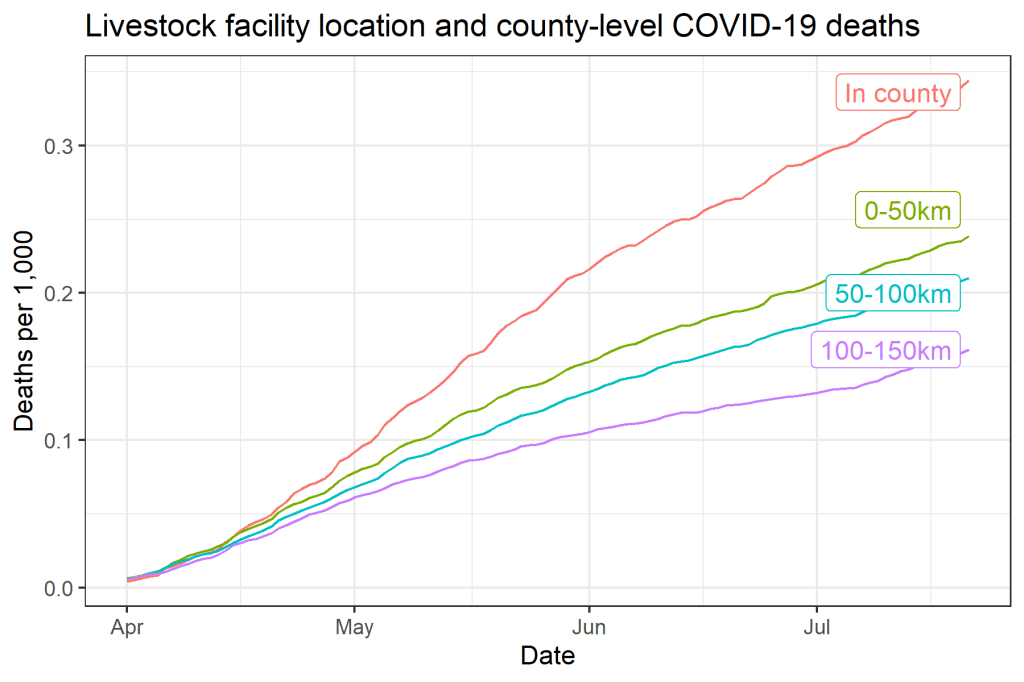
Policy responses to the COVID-19 outbreak must strike a balance between maintaining essential supply chains and limiting the spread of the virus. Our results indicate a strong positive relationship between livestock-processing plants and local community transmission of COVID-19, suggesting that these plants may act as transmission vectors into the surrounding population and accelerate the spread of the virus beyond what would be predicted solely by population risk characteristics. We estimate the total excess COVID-19 cases and deaths associated with proximity to livestock plants to be 236,000 to 310,000 (6 to 8% of all US cases) and 4,300 to 5,200 (3 to 4% of all US deaths), respectively, as of July 2020, with the vast majority likely related to community spread outside these plants. The association is found primarily among large processing facilities and large meatpacking companies. In addition, we find evidence that plant closures attenuated county-wide cases and that plants that received USDA permission to increase their production-line speeds saw more county-wide cases.
“Fertilizer and Algal Blooms: A Satellite Approach to Assessing Water Quality.” NBER Risks in Agricultural Supply Chains (with Geoffrey Heal), 2023.

Fertilizer is critical to agricultural supply chains, but its use results in downstream externalities in the form of aquatic hypoxic zones and algal blooms. Quantifying farm pollution is challenging due to its non-point nature and the lack of a temporally consistent, administrative-level dataset on water quality. This study offers a novel satellite-derived measure of algal bloom intensity that spans 30-plus years and encompasses lakes, riparian, and coastal aquatic resources across US counties. We show that fertilizer use is closely linked to our measure of water quality. Such farm pollution drives water quality impairment both locally and downstream from the fertilizer use, with impacts occurring at an annual and longer-term timescale (ungated).
“Tipping point dynamics in global land use.” Environmental Research Letters (with James Rising), 2021
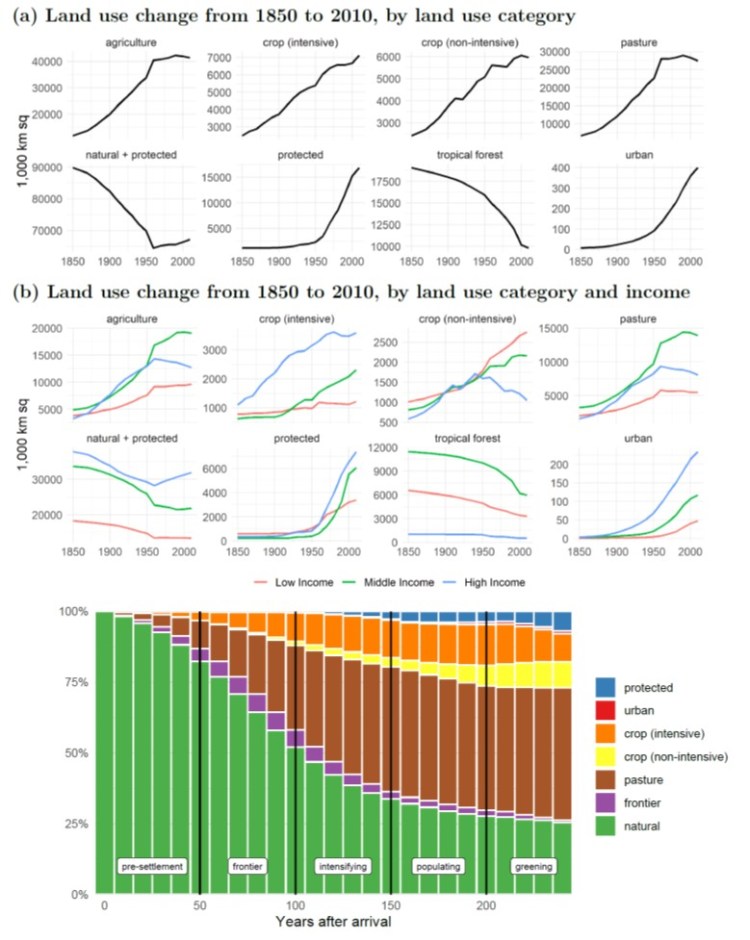
Agricultural land use has recently peaked, both globally and across country income groups, after centuries of expansion and intensification. Such shifts in the evolution of global land use have implications for food security, biodiversity loss, and carbon emissions. While economic growth and land use are closely linked, it is difficult to determine the extent to which the relationship is causal, deterministic, and unidirectional. Here we utilize gridded datasets to study long-term global land use change from 1780-2010. We find evidence for an economic tipping point, where land use intensifies with economic development at low income levels, then reverses after incomes reach a critical threshold. Cropland peaks around $5,000 GDP per capita then declines. We utilize a Markov model to show that this reversal emerges from a variety of divergent land use pathways, in particular the expansion of protected areas and a reduction in land use lock-in. Our results suggest that economic development remains a powerful driver of land use change with implications for the future of natural ecosystems in the context of continued population and income growth.
“Violent conflict exacerbated drought-related food insecurity between 2009 and 2019 in sub-Saharan Africa.” Nature Food (with W Anderson, C Taylor, S McDermid, E Ilboudo-Nébié, R Seager, W Schlenker, F Cottier, A de Sherbinin, D Mendeloff, K Markey), 2021

Conflict, drought and locusts are leading concerns for African food security but the relative importance and spatiotemporal scale of crises resulting from each hazard is poorly characterized. Here we use continuous, subnational data to demonstrate that the rise of food insecurity across sub-Saharan Africa that began in 2014 is attributable to an increase in violent conflict, particularly in South Sudan and Nigeria. Although drought remains a leading trigger of food crises, the prevalence of drought-related crises did not increase from 2009 to 2018. When exposed to drought, pastoralists experienced more widespread, severe and long-lasting food crises than people living in agricultural zones. Food insecurity remained elevated in pastoral regions for 2 years following a drought, while agricultural regions returned to pre-drought food-security levels in ~12 months. The few confirmed famines during the 2009–2018 period coincided with both conflict and drought, while locusts had little effect on food security during this period.
***
Covid-19 research
“The 1968 Influenza Pandemic and COVID-19 Outcomes.” Preprint on medRxiv (with Chris Boulos and Matthew Memoli)
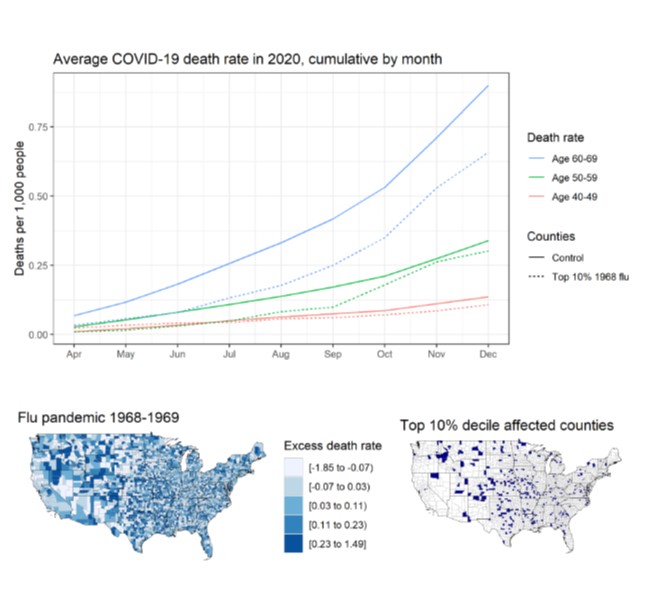
Past pandemic experience can affect health outcomes in future pandemics. This paper focuses on the last major influenza pandemic in 1968 (H3N2), which killed up to 100,000 people in the US. We find that places with high influenza mortality in 1968 experienced 1-4% lower COVID-19 death rates. Our identification strategy isolates variation in COVID-19 rates across people born before and after 1968. In places with high 1968 influenza incidence, older cohorts experience lower COVID-19 death rates relative to younger ones. The relationship holds using county and patient-level data, as well as in hospital and nursing home settings. Results do not appear to be driven by systemic or policy-related factors, instead suggesting an individual-level response to prior influenza pandemic exposure. The findings merit investigation into potential biological and immunological mechanisms that account for these differences—and their implications for future pandemic preparedness.
***

Media
Podcast on land use policy and climate change, Environmental Insights with Rob Stavins (July 2024)
Cicadas, insecticides and children, The Economist (June 2021)
OSHA issues a new Covid safety rule, but only for the health care industry, The New York Times (June 2021)
The market is betting on climate change, The Economist (March 2019)
After millennia of agricultural expansion, the world has passed ‘peak agricultural land’, Our World in Data (May 2022)
***
Contact
Charles A Taylor
ctaylor (at) hks (dot) harvard (dot) edu
 Charles A Taylor